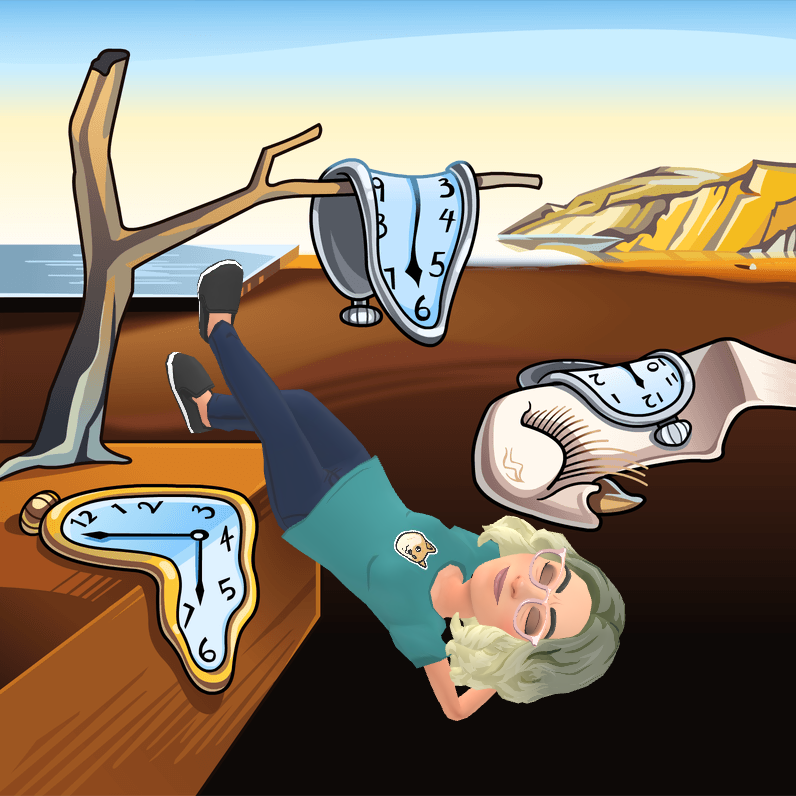
Can you identify these famous paintings?

I love silly quizzes that tell me which Star Wars character I am or whether I am an introvert or extrovert. I definitely take them with a grain of salt, but I do find them entertaining. What’s more, the suspense creates a great natural motivation to read. So here is one I find pretty generic and adds an educational aspect to it. But you can find the all the quizzes in the to get things going section of this Website.

Pre discussion

  • Have you ever done a silly pop-psychology quiz?
  • What was the result?
  • How much do you know about art?
  • What artists do you admire?

The Website

  • What was your result?
  • Which paintings did you recognize?
  • Which paintings left you puzzled?

Let me know how it goes…

Mel

8 secrets to success…can you name them?

Ah success! I feel as though this topic has been done to death. Yet I cannot resist this TED talk by Richard St. John. So short, so simple, so predictable, yet so thought provoking.

St. John interviewed over 400 people, some famous, to succinctly summarize the ‘ingredients’  to success. Although the results are not necessarily surprising, I think they are worth reminding.

Of course we all have our  cultural capital which is to say, depending on upbringing and background, some of us start the journey with a head start.  However, in St. John’s TED talk, he looks at the more unbiased predispositions that contribute success. It is a short presentation (3 min.) and may lead to some interesting personal anecdotes.

Pre discussion

  • Tell us about some of your successes. What do you think contributed to them?
  • Do a Mind Map the elements that contribute to success.

The Video: TED 8 Secrets of Success by Richard St. John

  • List each point
  • Do you agree with St. John?
  • Do you think he forgot anything?
  • Can you share a personal anecdote on one or of the elements?


What is in the news today?

The news can be a challenging thing to talk about. For intermediate to advanced students, it can be motivating to talk about real world topics. CNN offers a 10 min news recap every day. You can put the close captions on so the vocabulary can be heard and read and you can scaffold the activity by discussion what they know about the news. It is also a good natural context to speak in the past tense.

Pre discussion

  • What kind of news stories do you follow?
  • What are some of the top news stories these days?
  • What newspapers, blogs, news channels do you use to get your news?

The Video: CNN in 10

  • Make a list of the news stories
  • Do a Tell Back of what is said in each story
  • Is there a story that you would like to discuss?
  • Why is this story significant for you?
  • Were there some interesting words or vocabulary?

Have a good discussion.

Mel

Let’s get silly…Friday ice breaker questions…

Sometimes deep or thoughtful discussions are good for days when your brain juice is flowing. But today’s lesson is for the days when you just want to talk about silly stuff. Like “if you were a vegetable, which would you be.” Ok, maybe not that one, but you get the idea.

This is a site with some light hearted questions that are originally intended as ice breakers for a meeting (glad that the vegetable one never appeared in one of my meetings)…

Relax…have fun

For more like this, visit to get things going

How do you separate fact from fiction?

Fake news is the term “du jour.” How sharp do you think you are at spotting fake news?

What if you were a journalist? If your livelihood depended on your ability to detect fact from fiction? In Markham Nolan’s TED talk “How to separate fact from fiction online” we see how the digital dimension affects this decision.

WarmUp

  • How good are you at detecting fake news?
  • What is your criteria? How can you tell?
  • Do a Mind Map of the elements/criteria that can help separate fact from fiction.

The video: TED Markham Nolan: How to separate fact from fiction

  • Watch the video and gather some of Nolan’s debunking tools.
  • Compare your list with the mind map you did previously.
  • What elements in the digital information era make fact checking easier? What makes them harder?
  • Which anecdotes in Nolan’s talk stick with you? Why?

What museums would you recommend?

Why not indulged is some culture and beauty?

I love going to museums. They are like a breath of cultural air. Something about spending time with other people’s stories that inspires me.

Pre discussion

  • What type of museum do you enjoy (if at all…you can say you don’t like them…that’s ok too)?
  • What museums or exhibits have you been to that you would recommend?

The Article

Scan through this National Geographic article on the top 10 museums in the world and flesh out what makes each extraordinary.

  • Have you visited any of the museums on the list? What was it like?
  • Which museum would you visit?
  • What are some of the main attractions of each museum?
  • What type of museums do you like? Art? History? Science?
  • Do you have any memorable experiences at museums?

If you were a car, which would you be?

For all you car lovers our there, this is the discussion for you. Business Insider presents one of the world’s largest car collection of cars, with over 45o cars, held by business man Roger Dubbing. So if you want to feast your eyes on plenitudes of  chrome and leather, hop into this discussion…

First start by Mind Mapping some of the car related words. Perhaps this is a good opportunity to review colors, descriptive adjectives (e.g. fast, smooth, powerful, etc). Then ask your students to take the quiz. Why not make it interactive by getting your students into pairs so that one asks and the other answers. Reading out lound can be a great way to practice pronounciation…if it is not too difficutl or stressful. Finally, watch the video on the 45$ car collection.

Warm Up

  • Mind Map some of the car-related words
  • What is your favorite car?
  • If you were a car, which would you be? (you can even take a quiz)

The Video: Inside a $45 Million Car Collection

  • What did you see that stuck?
  • What are some of the strangest features?
  • If you were to rent a car from Dubbing, which would it be?
  • Why does Dubbing see himself as an art collector rather than a car collector?

What books do you want to read?

I know that the prospect of reading an actual novel in a second language may be much too ambitious a goal. However, I do like to sift through book reviews and talk about what students might like to read. And hey, it might get them interested enough that they will attempt it. If they do, I would not hesitate to encourage your students to get the audio version of the book as well.

I love audio books! Not only can I read while walking the dog, they provide a fantastic model of pronunciation and rhythm. Most “readers” even offer a speed feature where you can listen slower or faster. If this is something that could interest your students, send them to Audible.com or check with your local library (it will depend on the country you are in) to see what is available for free.

Pre reading discussion:

  • What was the last good book you read?
  • What did you like about it?
  • What kind of books do you like to read?

43 Highly Anticipated Books of 2019

Scan through some of the books on this page and pick one that catches your eye

  • Which book would you like to read and why?
  • What do you think the story will be about?
  • What books have you read in the past that are similar to this one?
  • Is there a pattern or theme to the books you like?

Have a great discussion!

What is your definition of success?

I don’t know anyone who gets up in the morning and says, “I hope I fail today.” Whether we like it or not, our need for success subtly–and not so subtly–influences how we move through our lives. Success can drive us, but also plague us. What’s more, it can be defined in so many ways. Money, fame, happiness, and many things can be considered hallmarks of success. So what are we chasing really? And are we chasing the right things?

Success and Culture

When I think of how multidimensional the concept of success can be, I actually feel overwhelmed. Sure, I have a personal definition of success, but how much of it is truly mine? How much is shaped by my family, my culture? And then all the micro-cultures: my work, my neighbourhood, my circle of friends. It is so expansive, it makes me dizzy.

You picked wrong…

And even more dizzying, according to Alain de Botton,  you can fail at prioritizing the right kinds of success. Our need for achievement can lead to unhealthy life choices and hyper-focus on external rewards–which can make it harder to listen deeply, take risk or to experiment freely. In Alain de Botton TED talk, he exposes his own struggle with success and some of the hidden forces that may shape the ambitions we chase.

Warm up

  • Name someone you consider successful?
  • What makes them successful? Money, fame, happiness?
  • Put the following elements in order of priority: happiness, family, work, relaxing, spouse, exercise, health
  • How is our relationship with success: healthy or unhealthy?

The Video: TED A Kinder, Gentler, Philosophy of Success by Alain de Botton 

  • Divide the presentation into 5 min segments and do a Tell Back
    • First 5 min: What is snobbery according to Botton?
    • 5-10 min: What is meritocracy? How might it be destructive?
    • 10-15 min: What can literary tragedy teach us? Why does nature attract us?
  • If you have time, I would suggest doing a Mind Map of the main elements that contribute to our notion of success. Perhaps group them according to those that are good and bad.

What is Brexit doing to the U.K.?

Whether you are for, against or take a neutral position of the Brexit negotiation, it is interesting to see how this deal is affecting British politics.

This New York Times video looks at some of the societal issues that prompted the need for Brexit. But now, it seems as though people are changing their minds. Why?

Warm up

  • What do you know about Brexit?
  • How do you think the people of the United Kingdom feel about it?
  • Where do you stand? For, against, neutral

The Video: New York Times-Brexit a disunited kingdom 

  • What are some of the actions you see?
  • What are the people feeling?
  • Can you do a Tell Back of some of the main points?
  • Do you think the people are changing their minds?
  • What do they hope to achieve in accepting/rejecting this deal?
0
0
0
1
0