Can you name a tiny awesome thing?

  • Level B1, B2, C1
  • Questions in post (so free)
  • Language focus: vocabulary of things
  • Competency: listening, reading and speaking

Why I Choose Uplifting Topics in my Classroom

I don’t know if you noticed, but given that this blog is dedicated to prompting discussion, most of my topics centre around uplifting positive subjects. It’s not that I am a “positivity shaman” who closes her eyes to the stressful realities in the world. And it certainly does not mean that I feel we need to crush negative feelings or deny ourselves time to grieve, or time to process life’s challenges.

Believe me, I think about difficult and uncomfortable topics too–political authoritarianism, human cruelty, isolation, stigmatization, loss and pain.

But when I step into the classroom, I choose to focus on things that help students feel grounded, hopeful and connected. I chose to talk about things we can control. Things that make us feel safe and seen. Things that build resilience and empathy.

1000 Awesome Things and Counting

That’s why it is no surprise that Neil Pasricha’s TED talk immediately grabbed my attention.

Can you name a tiny awesome thing is the question this work spurs in me. He can name 1000! And can we name more?

From getting the booth table in a restaurant to pulling on a warm pair of underwear just fresh out of the dryer, Pasricha’s blog 1000 Awesome Things, is a smorgasbord of little, everyday moments that often go unnoticed yet spark little joys. Moments that pass through us like tiny flints –quick bright sparks–before disappearing in the recesses of the ordinary unless we don’t stop and take notice of them.

From Thrill to Delight: A Powerful Classroom Resource

What makes this TED Talk such powerful material for a discussion class? First, it is fairly simple from a language perspective, making it ideal for ESL and secondary students. It also includes an immigration story, which might resonate with many of your students, and centres around three themes:

  • Awareness
  • Authenticity
  • Attitude
  • But mostly, it ignites a flood of little scenes that spark anything from quiet comfort to genuine thrill.

Warm up

  • Think of your day yesterday or today. Did anything spark tiny feelings of happiness?
  • If you were to look at the world for the first time, what would you notice?

Video: TED The 3 A’s of awesome by Neil Pasricha

Comprehension Questions

On the TED-Ed site, you will find 8 comprehension questions.

Discussion Questions

  • Can you share a time in your life when a change in attitude helped you through a difficult situation?
  • Why is authenticity important to small joys? (in the video Rosey Grier, the football player, and his love of needlepoint is given as an example)
  • Do you think authenticity makes life easier?
  • Which of the A’s (Attitude, Awareness, Authenticity) do you relate to most?
  • Why do you think it is easier to focus on negative things rather than positive ones?
  • How does social media affect authenticity?

Finally, take a look at the blog and see if you can add to it.

What is the worst or best rage bait you’ve encountered?

“A woman’s place is in the home”

“Immigrants should go back to their country”

“No doesn’t always mean no”

Did I trigger you? Do you want to tell me? Well then my rage bait trap worked. Rage bait is internet slang for when someone says something (usually online) in hopes of getting a reaction out of people. If you were to be scrolling through your phone and see a random video of someone saying something you absolutely disagree with, you might be tempted to leave a comment expressing your anger, however if you do, you are contributing to something much bigger than you think. 

The judgmental monster in all of us

Rage bait use a very powerful human trigger: judgement.  But by leaving a comment, the algorithm behind the post makes it more popular, thus suggesting it to even more people.  This causes it to be more and more seen and therefore make money. Sometimes people use rage bait as a form of publicity for their own product. For instance,  if you see something on Tiktok that makes you angry, and click on the creator you might see a link to a website trying to sell you something, this is one of the ways that indicate it is probably a scam.

A dark truth lurks

Unfortunately, among those who use rage bait for attention and money, there are some people who actually believe these ideas no matter how extreme.  Can you tell what is real and what is not? I can’t.

Alpha, Red Pill, Conservatism

Among the more debated points of view are those belonging to the rising conservatism voices.  One of the more disturbing trends is the Red Pill content that is gaining popularity among young boys. Seemingly an easy rage bait tactic–a thread dedicated to creating “safe space” where contributors vent their misogynistic grievances–it is also creating wide group of people who are inspired by it.

This scheme, used to make a small impact on your wallet, is making a much bigger impact on society and the next generation–a ripple effect that could impact the future more than you think.  What will happen if the young kids, responsible for building the future, head out into the world with a mindset that was spawned from anger and hatred? 

Discussion Questions

  • Have you seen or experienced rage bait?
  • What was your reaction? (see vocabulary below)
  • Now that you know about the algorithm, what will you do now?
  • How do you think rage bait effects younger audiences?
  • How can we protect them from it?
  • If rage baiters are really just trying to make money, is it really so bad?
  • Would you ever consider doing rage bait to earn some extra cash?

Vocabulary

Here is a list of words and expressions to help you express your opinions:

Critical:

Manipulative – This seems manipulative

Deceptive – The person is very deceptive

ExaggeratedThey exaggerated the situation.

Out of contextThat quote is taken out of context.

One-sidedIt’s a very one-sided argument.

UnverifiedThey shared unverified information.

Neutral

Not worth my timeI’m not going to argue about that.

Ignore itI just ignore that stuff.

Scroll pastI usually scroll past posts like that.

Let it goJust let it go.

Angry

infuriatingThat post is infuriating!

OutrageousWhat an outrageous claim.

DisgustingThat’s just disgusting.

I can’t believe thisI can’t believe people fall for this.

So unfairThis is so unfair.

They crossed the lineThat really crossed the line.

Surprised

ShockingThat video is shocking.

UnbelievableUnbelievable!

RidiculousThis is ridiculous.

Over the topIt’s way over the top.

Mind-blowingThat’s mind-blowing, in a bad way.

Feeling sick? What do you have?

It’s fall and the viruses are running amok. As I type these lines, I am sitting in bed, with my weekend pj’s, a box of tissues and a cup of tea at arm’s length…humph! What are my symptoms you ask? I am sneezing, I have a runny nose, I have a dry cough, I feel tired and I am congested. All expressions we only use once in a while but are crucial for a second language speaker to have.

When my daughter was three, she woke up looking pale and feeling awful. As the day went by, she started running a small fever. Normally I would have given her some acetaminophen and kept her quiet. But when my little teary girl put her hands around her collar and told me that her neck hurt, I immediately thought of meningitis. I went into full mommy panic mode and no sooner had I put her little coat on than we were in the emergency room. Once we saw the doctor, he deduced that “neck” meant throat in her language. She did not have meningitis, but just a bad cold. My point is, words matter, especially when talking about your health.

Lessons introducing health vocabulary can be interesting because you can pack a lot into them. Given it is a familiar subject in our first language, the task really boils down to having English equivalent to words your students already know–which can feel really satisfying. But if you add some role-playing, you can review yes/no questions, give treatment advice with verbs in the simple present and even learn a thing or two about which symptoms can considered serious or not.

If you are looking for a first-language site to use as a reference or even a role-play launch pad, check out some of my favourite go-tos…

  • Pharma giant Pfizer has a nice little reference sheet that can be used for a role-play Q&A.
  • WebMD has symptom checker that can be interesting to play around with
  • And for advice and recommendations, WebMD has a nice article all headed with verbs.
  • WebMD also has a simple article on home remedies “that work”

What should I wear today?

3 great sites to role-play shopping for clothes

I don’t know about you, but I love getting dressed in the morning. I know, not everyone does, but I do. In fact, there is a whole other version of me in a multiverse somewhere who is a fashion stylist. I love the colours, the textures the shapes and what style conveys to your entourage.

I also love teaching the vocabulary related to clothes and style in my ESL classes. We go “shopping” and role-play asking for certain pieces including colours, price, size, etc. But as with everything, I like to use real websites to do this following the Whole Language method. However, I am selective with my sites. They need to be clean, have clear names for the clothes (sometimes marketing can make things more complicated than it needs to be) and have good descriptions. Full disclosure, I have taken some writing contracts where I produce those descriptions, so I am especially critical of quality language there.

Here are some of my favourites sites and why:

Banana Republic

I can barely afford the clothes at BR, but I appreciate the simplicity of the pieces and the short, but well-crafted descriptions.

Charlie B

Clothes are for women only, so that is a bit of a bummer, but the descriptions tell a story. So nice. Make sure you click on the drop downs, it will tell you “Why we love it” which is great vocab for the role of the salesperson, and also gives you advice on what to wear it with. And it’s Canadian ❤️

Nordstrom.com

The descriptions are short, but full of juicy adjectives. They also carry shoes which can enhance your dialogue options.

DISCLAIMER😜

You might be tempted to buy. I get no commission on sales. Yes I love to shop, and yes I like these shops, but mainly I like these sites because the sites are easy to click through and the descriptions are well written and interesting to teach with.

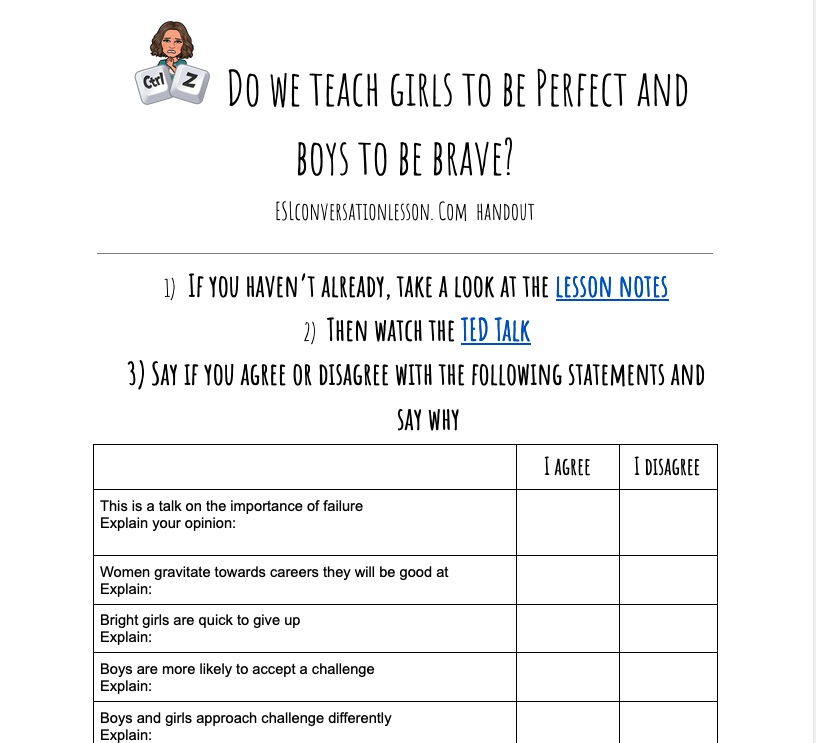
Why do we teach boys to be brave and girls to be perfect?

  • Language focus: comparisons, hypotheticals
  • Media: video

Now that is a loaded question if I ever did blog one. Admittedly gender difference always creates discussion. But not always the discussions I like to facilitate. In fact, I usually stay away from overly simplistic comparisons, especially when they pit the two most basic attributes of humanity. However, when I watched Reshma Saujani’s TED talk, I instantly wanted to talk about it.

Can it be true? And what if it is?

Saujani hammers a societal observation that had me searching all my memories as a young girl. Do we teach our boys to be brave and our girls to be perfect? And the follow-up question: how has this shaped our society? Said differently, how has this impacted our job market, our political paradigms, technological progress, social and familial priorities…the list goes on.

CTRL Z please!

Saunjani strikes a particularly sensitive chord when she describes some of the anecdotes from her coding school for girls. She describes a girl sitting in front of her blank coding screen, feeling like she is just not good enough to compose code that will work. But when you do CTRLZ (undo) to go back a few keystrokes, she finds pages full of code that was deleted that simply “wasn’t good enough”.

Warm Up

  • Mind Map some of the biases we have about girls and boys (e.g. girls and creative and boys are good at math, boys are more physical, etc.)
Handout on TPT 0.99$

The Video: Teach girls bravery, not perfection by Reshma Saujani

Can you spot the lie?

Can you spot the lie? We would play this game for hours in long car rides. The object is to tell two things about yourself that are true and one thing that is false. The other participants have to say which they think is the lie.

Rules

  • Each player thinks of three anecdotes. Two should be true and one should be false.
  • Each player takes turns saying their anecdotes.
  •  The other players have to say which anecdote is a lie.

That’s it. It’s a simple game that can be tons of fun. Let me know how it goes.


What is Brexit doing to the U.K.?

Whether you are for, against or take a neutral position of the Brexit negotiation, it is interesting to see how this deal is affecting British politics.

This New York Times video looks at some of the societal issues that prompted the need for Brexit. But now, it seems as though people are changing their minds. Why?

Warm up

  • What do you know about Brexit?
  • How do you think the people of the United Kingdom feel about it?
  • Where do you stand? For, against, neutral

The Video: New York Times-Brexit a disunited kingdom 

  • What are some of the actions you see?
  • What are the people feeling?
  • Can you do a Tell Back of some of the main points?
  • Do you think the people are changing their minds?
  • What do they hope to achieve in accepting/rejecting this deal?
0
0
0
1
0