What helps you feel brighter during the darkest, coldest months of the year?

Picture a fireplace roaring, the smell of baked goods in the kitchen, music in the background, a hot beverage, or a little cocktail–you can’t help feeling the warm fuzzies, can you? These are classic soul-lifting ingredients.

Did you know that this is also the basic theme of the Winter Solstice and even the root of many Christmas traditions? After years as an ESL teacher, I find this time of year is sometimes a little tricky to talk about in class. Christmas is exploding everywhere, but not for everyone. That’s why I prefer to introduce the holiday season through its precursor: the Winter Solstice.

Warmth and Light for Everyone

The Winter Solstice is one of the most universal celebrations in the world — and one of the easiest for ESL students to connect to, no matter their cultural or religious background. What makes it so rich for class discussion is that it’s a non-denominational event based on nature, not religion. The days grow shorter, the nights grow longer, and it can get a little depressing when the sun goes down at 4:00 p.m. We need a collective “pick-me-up” do you think?

How to we do this? We respond to this darkness in similar ways across the world: we decorate with lights, share food, exchange gifts, listen to music, and gather with people we love. These traditions help us feel hope and joy during a cold and difficult time of year.

The Comfort of Traditions

Many modern celebrations, including Christmas, use symbols that come from ancient solstice traditions. For example, decorating trees with lights, sharing meals, and giving gifts are always to bring light into the darkness — both literally and emotionally.

If you want to discuss traditions with your students, I found this interesting article in Reader’s Digest on festive traditions around the world. Then I suggest you open the discussion with some traditions your students might like to share under the umbrella of “Making Spirits Bright.”

Warm up

  • Mind map some of these words (which are also in the article): darkness, light, hope, feast, tradition, comfort, gather, celebrate, return, gift-giving
  • Why does giving and receiving gifts make people feel good?
  • Do you celebrate something in winter?
  • What helps you feel connected to others?

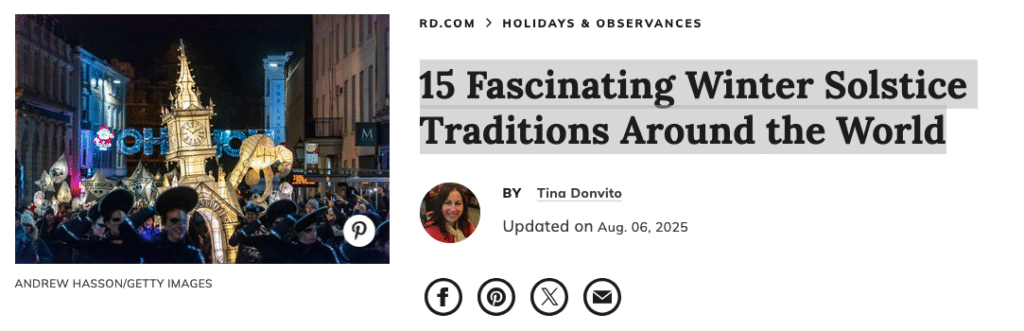
The article: 15 Fascinating Winter Solstice Traditions Around the World
Discussion Questions

  • What is the Winter Solstice — why is it significant for many cultures?
  • Name two different solstice traditions from around the world described in the article. What do people do in those traditions?
  • Why do many solstice celebrations involve food, family gatherings, or rituals at night or with lights? What might these actions “represent”?
  • According to the article, how is the solstice connected to some modern holidays (or winter celebrations)?
  • Which of the solstice traditions you read about would you like to try?
  • Why is community especially important during the darker, colder months? Is there a downside to getting together?
  • In your own culture (or family), are there traditions or habits that feel similar to solstice celebrations.

Do you believe in ghosts?

Turn off the lights and get the flashlights out.–it’s time for some ghost stories! When I was a teenager, we used to break out the Ouija board and pretend that spirits were floating around us, trapped in a silent world desperate to make contact. The room would be hushed, someone would stiffle a nervous laugh and furtive glances would dart to see who truly believed and who was just pretending. We’d ask the “Ouija Master” all kinds of crazy questions, haf-convinced that as the glass slid along the board, we were brushing against the world beyond.

To be honest, I’m not sure what I believe when it comes to ghosts, but I do love a good ghost story. So many evenings spent swapping tales of flickering candles, Grandma’s favourite serving dish mysteriously appearing on the table, ghost dogs coming to deliver warnings, and shadows creeping along the walls before vanishing into the corners. Just writing about it is giving me goose bumps.

Here is my suggestion: invite your students to share ghost stories of their own– it can be inspired a real experience or totally invented. Alternatively, have them read this article and summarize one of the 10 real-life ghost stories. Then gather everyone in a circle, turn off the lights, and set the mood by playing a virtual fire on your smartboard or even on a tablet or Chromebook placed in the center. Now let the storytelling begin!

Warm up

  • Do you believe in ghosts? Why and why not.
  • Why do you think horror movies and ghost stories are popular?

Article: 10 Scary Ghost Stories to Make You Sleep With the Lights On-(source: USA Today)

Discussion Questions

  • The article mentions places being “haunted” because of their history or atmosphere. What factors make a place feel haunted? Can you think of a place you know that would fit those factors?
  • Which type of explanation seemed most convincing to you, and why?
  • If you were to write your own ghost story (based on the article’s style), what setting would you choose (house, hotel, old forest, etc.) and what would the ghost be trying to say or do?
  • What lesson(s) do you think a ghost story can teach us (even if we don’t believe in ghosts)?

Happy Halloween everyone!

Try something new for 30 days

I recently read the book The Midnight Library by Matt Haig. In the book, the main character visits a library in a parallel dimension where each book represents one of her possible lives…should she have made different choices. The journey takes us into multiple different versions of this character, Nora Seed. She is a rock star, a mother, a glaciologist, an Olympic swimmer, a philosophy professor and the list goes on. In each life, Seed has the luxury of measuring the level of happiness and fulfillment the different paths procure her.

What if

It is the classic “what if”, question. Of course, it got me thinking of my own life. Then, instead of delving into regretted choices or getting depressed about what could have been, I thought of this TED talk by Matt Cutts: Try something new for 30 days. Since we cannot travel into parallel universes to see what could have been, Cutts’ idea is the next best thing.

Parallel Lives for 30 Days

We have all heard it before, we must step out of our comfort zone to grow…right? Cutt’s takes this to the next level with his self-imposed 30-day challenge. What I like about Cutt’s talk, is it gives a more tangible objective to this idea of trying new things. It may not be as profound as the Midnight Library, but it’s a start. After all, what’s 30 days?

Warm-up

  • What new thing would you like to try but haven’t yet?
  • What does it mean to “step out of your comfort zone”?
  • What are the benefits of doing new things? Any disadvantages?
  • What are the benefits of sticking with what you know? Any disadvantages?

The Video: Try something new for 30 days

Discussion Questions

  • Why does Matt think this is a good idea?
  • What did it change in his life?
  • What areas of our lives could we apply this to? Make a Mind Map
  • Do you have any spontaneous ideas that you might like to try for 30 days?


Do you have a job or a mission?

  • Level: B2-C1
  • Discussion questions included in the post
  • Media: Video
  • Language focus: jobs, hypotheticals, modals

Do you have a job or a mission?

Celeste Headlee, a trained opera singer turned radio show host, has some rather interesting insight to share about the difference between a job and a mission. She also has a lot to say about how we get stuck focusing on our education and job expectations. But if you think she gives the same old spiel about finding your passion, being brave and embracing your true calling, you would be wrong. She knows we all have mortgages, rent, food, and stuff to pay for. Moreover, she also knows that finding your passion is complicated, changing, and doesn’t always match the needs of the market. Thankfully, she is not going to tell you to quit your job or sit at the top of a mountain to meditate.

Practical vs. Ideal

This is the third post on this series on jobs and careers. So far we have gone through some basic vocabulary and explored what jobs are out there and then saw some fun ways to go about choosing. In this post, we will take a more analytical approach and explore the skills connected to jobs. We are going to exercise our mental flexibility and examine the components of various jobs or fields and see how they can apply to other jobs and fields.

Warm up

  • What do you think is the difference between a job and a mission?
  • How many job-related skills can you name? e.g. if you are a teacher, that means you have skills in public speaking, pedagogical design, presentation design, audience analysis, planning, leadership etc.

The Video: TED Don’t find a job, find a mission

Discussion questions

  • Do a Mind Map or recap of all the main points of the talk (see our list)
  • What do you do? What are the skills involved in your job?
  • Do you like your job? What do you like and don’t like?
  • What things do you look for when looking for work?
  • If you were to do something completely different, what would it be?
Bitmoji Image
Profession: super hero

What are your thoughts on Omicron breakthrough infections?

Great ESL lesson to explore the information about breakthrough infections and on Omicron.

  • Level: B2, C1, C2
  • Activity: True/False handout on TPT (0.99$)
  • Language focus: emotions vocabulary, science, health
  • Media: video

What are your thoughts on Omicron? Are you frustrated that despite all your efforts, people (maybe even you) have gotten sick? Are you afraid of the next variant? Are you vaccinated, boosted and wondering why you bothered? Or do you see Omicron as the beginning of the end of a pandemic that has changed us in so many ways we still can see the forest for the trees? Perhaps you see Omicron as a blessing, a harbinger of better times yet to come.

All of the Above

If I am being totally honest, I feel all those things. I am vaccinated, boosted, wear my mask everywhere I go, wash my hands obsessively and analyze every sneeze, cough and sniffle with scientific discipline. I am a goody-goody who did everything public health officials recommended. Do I regret it? No, absolutely not? Do I sometimes wonder if it was too much? Yes, sometimes.

Give me the Facts…Again

That is why I really appreciated, Jo Hanson’s video Here’s What I Learned from Getting COVID. The host of PBS’s It’s Ok to be Smart is pro-vaccine, pro-mask, pro-anything-that-will-protect-the-population (see Masks vs. Corrona, lesson), and got COVID anyway. He candidly shares his frustration. Still, without defending or trying to convince, he diligently gives a fact-based explanation of why this happened and why it is still important to do everything in our power to stop the spread.

Warm-up

  • Elicit people’s thoughts on Omicron: is it a blessing or a threat
  • How does this new variant make them feel? Helpless, no big deal, ready for another wave, discouraged, scared.
  • What do we know about the virus?
  • (I would stay away from a pro or against discussion on vaccines if I were you)
  • Go through the statements on the handout and make predictions of the answers
Handout on TPT 0.99$

The video: It’s Ok to be Smart– Here’s What I Learned from Getting COVID

Discussion

  • You can use the handout to talk about the various points made in Jo’s talk
  • What do you think are the key ‘take-aways’ on vaccines, the severity of Omicron, what attitude we should adopt to stay safe AND stay sane?

Amy Cuddy: Can my body language affect my mood?

Can my body language affect my mood? Your body language may not only affect how people perceive you, but it may also have an impact on your brain chemistry. Watch Amy Cuddy’s famous TED talk (I suggest you break it down into smaller parts and do short Tell Backs) to find out just how profound the way we carry ourselves changes our outlook.

Teachers note: 

Cuddy speaks fast, but the vocabulary is relatively repetitive and she uses a lot of non-visuals. I would encourage you to preface this video with a bit about the Whole Language Approach. Tell them that they don’t have to understand everything. Review some of the meta-tools they have to achieve comprehension: non-verbal language, guessing from context. It may be frustrating for adults not to understand everything, but I feel it is important to expose them to first language material to prepare them for real-life conversations with native speakers. Thus the more they get used to (by that I mean get used to not understanding everything) quick-talking native speakers the more they will likely take their English out and use it.

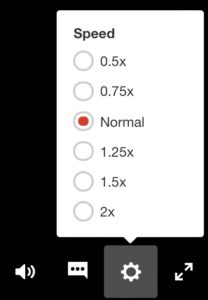
Also, you can add subtitles and slow the video down a bit with these features:

Pre discussion

  • Some vocabulary:
    • posture
    • body language
    • non-verbal behaviour
    • power dynamics
    • power and dominance
    • assertive
    • optimistic
    • hormone
    • fake it t’ill you make it
  • What kind of body language makes a good impression? 
  • How important do you think body language is in communication

*You could cut the video at about 14:00 where Cuddy describes the study that supports her findings. Unless you find that interesting (which it is) it might be a little detached from the general point.

The Video: TED Amy Cudy Your body language may shape who you are

What is the most important element that Cuddy is highlighting?

Why is it important to be “body aware”?

What will happen if you change your body language the way Cuddy suggests?

What can you conclude about the impacts of posture on our outlook on life?

For more on this topic see Body Language Mistakes

Bitmoji Image

Where did you go on vacation?

Where did you go on vacation?

A simple question to start off the new eslcoversationlesson.com season. Of course, not everyone goes on vacation, but usually, the summertime presents opportunities for special visits, adventures, road trips and vacations. I love my vacations. My family and I look forward to them all year. And then, when they are over, we talk about them all year.

There is so much more that happens other than the vacation. No television (less of it anyway), we spend our days together, we eat special food, do activities we have never done before–It is a total break in the routine.

Hiking in Vermont

That’s why this week’s theme will be devoted to summer, vacations and routine-breakers.

Warm up

Do a quick Mind Map of the vocabulary associated with vacations.

The Discussion

My colleague Larry Pitts has an absolutely fabulous site chalked full of open-ended questions. I think this is the perfect place to start our vacation discussion.

Click on the image to go to the site.

The next posts will feature a video or perhaps an article, but for today, the good ol’ Q&A will do the trick.

Bitmoji Image

What are the top 5 vacations…just for you?

Are you ready for a vacation, but don’t know where to go? Have I got a fantastic tool for you. The Washington Post offers this wild vacation planner tool. All you have to do is answer their questions and the computer will generate the top vacation spots based on your answers.

Is that not an awesome ESL exercise! I was beyond tickled when I stumbled on this gem of a website. Not only is it super useful for the common mortal, but it is also a fantastic speaking, reading and conversation exercise.

The questions are interesting and the options are funny. You may need to help the students with some of the jokes and figurative language, but once they understand that they don’t really have to understand everything verbatim, they should have a good time.

The articles are well written, perhaps a little challenging at times, but include many pictures.

How I would Teach This

  1. Get students in pairs. One person asks the questions and the other answers
  2. Let the computer generate the results
  3. Ask each student to choose an article, even if they are not the traveller. Each read and then do a Tell Back on the content.
  4. Switch roles and repeat steps 1 to 3.

The article: Washing Post Vacation Finder

Washington Post Vacation Finder

Let me know how it turns out.

Bon voyage

What do your hobbies do for you?

What do your hobbies do for you?

Do you knit, run, read, eat, garden? Hobbies are acticities that we do for the sheer pleasure of doing them. They help us take time for ourselves. Whether they are sports related or a more relaxing activity, a hobby is something to enjoy. In other words, when you have given them a bit of time, you feel recharged and happy–as opposed to guilty or tired.

Personnally, I have more hobbies than I probably should. I love relaxing. I knit, paint, garden, cook, take long walks with my dog, read and write blogs. In fact, my hobbies help me channel a lot of creative energy. My husband on the other hand uses hobbies like obsesive video game playing to expell his stress. I’m not sure that it works though.

Moreover, not everybody nutures hobbies. In fact, in many cultures hobbies can be viewed as lazy or a waste of time–something you do when you are children or you want to avoid ‘real’ work. What do you think? Are hobbies healthy or a waste of time? In this Huffington Post article, the author develops the idea that there are good and not so good hobbies.

Warm up

Do a Mind Map of the different hobbies.

The Artcle: Healthy Hobbies That Will Improve Your Life

  • Scan for words that describe the benefits of hobbies.
  • What hobbies do you have?
  • Out of the 11 hobbies listed in the article, which would you like to try?
  • What is it about that activities that sparks your interest?

Do you eat…environmentally?

Being environmentally mindful can mean much more than composting your food scraps and recycling packaging. There are hundreds of little gestures that can contribute to making the planet healthier.

How many try to pack litterless lunches? Do you use plastic produce bags for your fruits and vegetables? Do you use reusable shopping bags? And more importantly, do you think that any of this makes a difference in the planet’s health?

And what about the way we buy food. Do you try to buy local? Can you tell which is local from the imported stuff? What do you know about how your food is produced? If you are like me, probably not enough.

If we look at food buying trends, it would appear that we are trying to shop and eat smarter. So what do you think that means? In this PBS Hot Mess feature, they take a look at global food production and why it is so hard to change methods that are depleting the planet of its resources.

About the video: the information is not always easy to follow. It is full of government references (I guess it must be interesting for someone) and they bring up many questions but don’t really get to the answers. Still, I suggest you get through to the end. The conclusion carries many of the main messages and leaves a few concrete things to think about.

Warm-up

  • How have you changed the way you buy food in the last 10 years?

The Video: PBS Hot Mess Food vs. Climate Change

Discussion

  • First, do a global Tell Back of the video…broad strokes.
  • What do they mean by a universal food reference?
  • Does eating more fruit and vegetables help the environment?
  • Why is it hard to change our food habits?

Agree or disagree

  • Adopting a universal reference diet is easy
  • To reduce carbon emissions, all we have to do is eat less meat
  • If people knew more about how food is produced we could change damaging food production practices
  • There is nothing we can to do change food production
1
0
0
0
0