What helps you feel brighter during the darkest, coldest months of the year?

Picture a fireplace roaring, the smell of baked goods in the kitchen, music in the background, a hot beverage, or a little cocktail–you can’t help feeling the warm fuzzies, can you? These are classic soul-lifting ingredients.

Did you know that this is also the basic theme of the Winter Solstice and even the root of many Christmas traditions? After years as an ESL teacher, I find this time of year is sometimes a little tricky to talk about in class. Christmas is exploding everywhere, but not for everyone. That’s why I prefer to introduce the holiday season through its precursor: the Winter Solstice.

Warmth and Light for Everyone

The Winter Solstice is one of the most universal celebrations in the world — and one of the easiest for ESL students to connect to, no matter their cultural or religious background. What makes it so rich for class discussion is that it’s a non-denominational event based on nature, not religion. The days grow shorter, the nights grow longer, and it can get a little depressing when the sun goes down at 4:00 p.m. We need a collective “pick-me-up” do you think?

How to we do this? We respond to this darkness in similar ways across the world: we decorate with lights, share food, exchange gifts, listen to music, and gather with people we love. These traditions help us feel hope and joy during a cold and difficult time of year.

The Comfort of Traditions

Many modern celebrations, including Christmas, use symbols that come from ancient solstice traditions. For example, decorating trees with lights, sharing meals, and giving gifts are always to bring light into the darkness — both literally and emotionally.

If you want to discuss traditions with your students, I found this interesting article in Reader’s Digest on festive traditions around the world. Then I suggest you open the discussion with some traditions your students might like to share under the umbrella of “Making Spirits Bright.”

Warm up

  • Mind map some of these words (which are also in the article): darkness, light, hope, feast, tradition, comfort, gather, celebrate, return, gift-giving
  • Why does giving and receiving gifts make people feel good?
  • Do you celebrate something in winter?
  • What helps you feel connected to others?

The article: 15 Fascinating Winter Solstice Traditions Around the World

Discussion Questions

  • What is the Winter Solstice — why is it significant for many cultures?
  • Name two different solstice traditions from around the world described in the article. What do people do in those traditions?
  • Why do many solstice celebrations involve food, family gatherings, or rituals at night or with lights? What might these actions “represent”?
  • According to the article, how is the solstice connected to some modern holidays (or winter celebrations)?
  • Which of the solstice traditions you read about would you like to try?
  • Why is community especially important during the darker, colder months? Is there a downside to getting together?
  • In your own culture (or family), are there traditions or habits that feel similar to solstice celebrations.

Do you believe in ghosts?

Turn off the lights and get the flashlights out.–it’s time for some ghost stories! When I was a teenager, we used to break out the Ouija board and pretend that spirits were floating around us, trapped in a silent world desperate to make contact. The room would be hushed, someone would stiffle a nervous laugh and furtive glances would dart to see who truly believed and who was just pretending. We’d ask the “Ouija Master” all kinds of crazy questions, haf-convinced that as the glass slid along the board, we were brushing against the world beyond.

To be honest, I’m not sure what I believe when it comes to ghosts, but I do love a good ghost story. So many evenings spent swapping tales of flickering candles, Grandma’s favourite serving dish mysteriously appearing on the table, ghost dogs coming to deliver warnings, and shadows creeping along the walls before vanishing into the corners. Just writing about it is giving me goose bumps.

Here is my suggestion: invite your students to share ghost stories of their own– it can be inspired a real experience or totally invented. Alternatively, have them read this article and summarize one of the 10 real-life ghost stories. Then gather everyone in a circle, turn off the lights, and set the mood by playing a virtual fire on your smartboard or even on a tablet or Chromebook placed in the center. Now let the storytelling begin!

Warm up

  • Do you believe in ghosts? Why and why not.
  • Why do you think horror movies and ghost stories are popular?

Article: 10 Scary Ghost Stories to Make You Sleep With the Lights On-(source: USA Today)

Discussion Questions

  • The article mentions places being “haunted” because of their history or atmosphere. What factors make a place feel haunted? Can you think of a place you know that would fit those factors?
  • Which type of explanation seemed most convincing to you, and why?
  • If you were to write your own ghost story (based on the article’s style), what setting would you choose (house, hotel, old forest, etc.) and what would the ghost be trying to say or do?
  • What lesson(s) do you think a ghost story can teach us (even if we don’t believe in ghosts)?

Happy Halloween everyone!

Do you talk to strangers?

Do you talk to strangers? Maybe we should.

Did your mother tell you not to talk to strangers? Mine did. Was that really good advice? Of course, we don’t want to compromise the safety of our children and we are not all social butterflies. We have our personalities and our boundaries and it is important to respect ourselves in that way.

How to break isolation

But isn’t there something alarmist, maybe even cold, about stranger danger? Are we encouraging isolation, apathy, disengagement, fear, tribalism? Even though it is natural to gravitate toward people who have familiar ideas and beliefs, could we be missing something in those who are different from us?

In Malcolm Gladwell’s new book “Talking to Strangers” he exposes how opening ourselves up to others has a lot to teach us. But it is not all touchy-feely shiny happy people communing. Talking to strangers can be very destabilizing and may even reveal or confirm that there are some twisted people out there. Not everyone is truthful and not everyone is empathetic. But some are, and by closing ourselves off for fear of landing on a bad one, we are pruning our outlook and our own empathy.

Talking to strangers is the key to more peace

Justin Trudeau’s keynote address to the NYU graduates takes this notion to the next level. He calls us out on our hidden biases, our fears, our tribalism. He wants to inspire us to have courage and get to know those who make us uncomfortable, get to know those who don’t resemble us and get to know those who don’t think like us. For him, and perhaps for Gladwell as well, talking to strangers is the path to world peace…no less.

Warm up

  • What do you think talking to strangers can achieve?
  • Why is it so difficult for us?

The Video: Justin Trudeau Diversity doesn’t have to be a weakness!

Discussion Questions

  • What are some of the main messages that stuck with you?
  • What does Trudeau mean when he talks about ‘tribalism’?
  • What does he mean when he says “win the argument”?
  • What can we do to know the good strangers from the bad strangers? Are there tools, tricks?
  • Do you think Trudeau is being naïve? In what way?
  • What are some of the ‘juicy’ words and expressions? Make a list and see if you can put them in other sentences.

What is your comfort food?

What is your comfort food? I dare you to NOT think of the answer. Too late? I bet your favourite dish is already in your mind. Maybe you are even seeing a memory or a person attached to this dish. Is it something your mother made when you were sick? Something you eat at Christmas? Is it sweet or salty?

Healthy…probably not

Chances are your comfort food is not too healthy. Right? Generally speaking, comfort foods are hardy, starchy and fatty. All great words that describe food. And that is exactly what you will find in this Insider Food video featuring 20 different people from 20 different cultures describing their comfort food.

But it makes me happy

Food makes people happy, conjures memories, and heals us when we are sick or sad and is often the heart of most celebrations. It is also a super fun thing to talk about. It ties in food, feelings, events and people, thus a nice integrated vocabulary exercise. The perfect Whole Language exercise.

While you listen

This video is chalk-a-block full of vocabulary, so I made a Google docs handout available through Teachers Pay Teachers to help collect the essential ideas. Or you can try this cool interactive worksheet. Of course, if you are working with more advanced students, you might want to ditch the handout and just let the students note what they can. Rember you can turn the CC on and slow down the video.

Google Docs Handout

Pre Discussion

  • Just to get the food words flowing, do a Mind Map
  • What is your comfort food?
  • Why?

The Video: 20 Comfort Foods From around the world

Discussion

  • Which story did you find the most interesting?
  • Which dish have you tried?
  • Which dish would you like to try?
  • What do most of the dishes have in common?
  • What were some of the reasons the dishes were considered comforting?

7 types of icebreakers that will get your students laughing, thinking and connecting

The art of asking the perfect question is my own personal Mona Lisa. It is the element in my practice that I am always improving and perfecting. In fact, I even made a little video about some of the cognitive elements involved in questions.

Let go of perfection

Crafting a perfect question takes audience intuition, subject knowledge and most of all genuine curiosity about the result. But getting it right can be a mix of experience, trial and error and just plain luck. Jump in with something you find interesting and see where it takes you.

Have my questions bombed? Oh yes. Have I had the uncomfortably long blank stare? Yep. I have even been asked why on earth I would ask such a boring question. Ouch.

Most of all, when you are ‘on’ and right in the middle of a lesson, you need a certain amount of preparation, as well as have enough spontaneity to roll with the group if they want to go another way.

listen for patterns

It is the simplest yet the most powerful tool to see how articulate and fluid your students are. If you can, try to set an intention for what you listen for. Perhaps you can focus on speaking patterns like verbs, or use of modals, or vocabulary from previous lessons. If you notice mistakes, try to pick the most prevalent pattern and then give it some attention. Or perhaps you notice that the students are incorporating a bunch of previously learned vocabulary–make sure you point it out and praise them.

Question Tag-You’re it!

During the COVID confinement, I taught an online conversation course with about 10 students at a time. To allow everyone to speak, we played a game I called “question-tag”.

Students choose a question from the list and ask another classmate. Then that classmate is “it” and chooses the next question and classmate. Simple concept, but it puts the control in the students’ hands and adds just a touch of suspense to keep people engaged.

Want to play…You can use these 7 types of icebreakers to get going. The questions are meant as a corporate team-building exercise. Thus they are authentic and funny. Let me know how it turns out.

How exactly does gender work?

Books have been written about it, alcohol-based dinners never go without it, and more recently, we are digging into what defines it.  Put simply, what are the differences between men and women? This TED talk by biologist Karissa Sanbonmatsu really got my attention. First of all because she presents some of the new discoveries from epigenetics and research in DNA that explain the differences between men and women from a biological perspective. Gotta love science. This lesson is filled with tons of scientific vocabulary to describe how DNA works to create gender differences.

However, here is the twist, Sanbonmatsu, a transgender scientist, also talks about the challenges she faced through her struggle with her own identity. This content is layered and complex. On one hand the objective is to help science-based students become more verbal with DNA related vocabulary–an important corner stone topic for biologists. But beyond that, the speaker pulls in the social challenges of the “old boys club” that exists in the scientific community as well as the very misunderstood transgenderism.

Pre discussion

  • What are some of the theories you have heard about the differences between men and women?
  • Do you think there are differences?
  • What does it mean to be transgender?

The Video: The Biology of Gender

There are really two aspects in this video mashed up together. 1) Sanbonmatsu shares the science of gender. 2) Sanbonmatsu talks about the reactions of her scientific community towards transgenderism.

I would first untangle each aspect.

  • What does the latest research tell us about gender?
  • What is the behaviour of our DNA?
  • How is Sanbonmatsu contributing to a society of tolerance inclusion?
  • Why does Sanbonmatsu expose the scientific community as being especially hard on her choices?
  • Do you think there are other social circles where transgenderism is more difficult?
  • What about less difficult?

I leave you with that for the weekend…have a good one.

Mel

Why do we believe weird things?

  • Level: B1, B2, C1
  • Handout on TPT
  • Media: Video
  • Language focus: beliefs, superstitions, conspiracy theories, fake news, disinformation.

Why do we believe weird things?

Fake news, misinformation, disinformation, these concepts are all over the media. We all know it’s out there, but how can we tell what is true and what is fake? First, let’s play a game…

True or False

  • Salt makes water boil quicker.
  • You should never swim right after you eat
  • Some people are more right-brain thinkers and others more left-brain thinkers.
  • Toilets flush differently in the southern hemisphere than the northern hemisphere.
  • Einstein failed math.
  • Humans and dinosaurs co-existed
  • Vaccines cause autism.
  • You need to wait 24 hours to file a missing person’s report.
  • We use only 10% of our brain.
  • Most of our body heat leaves through our heads.
  • You should never wake a sleepwalker.
  • Bats are blind.
  • Alcohol keeps you warm.
  • Sugar creates hyper children.
  • Your hair and nails keep growing after you die.
  • Slaves built the pyramids in Egypt.

In case you use this to generate discussion with your class, I won’t give you the answers. You could invite your students to check for themselves at Readers Digest.

It’s your brain’s fault

Famous debunker and Skeptic.com’s editor-in-chief  Michael Shermer gives us a bit of insight into how our brain is wired to makes us believe weird things.  He explains and demonstrates how things like priming and cognitive bias are natural neurological predispositions that lead us to faulty conclusions. This discussion utilizes vocabulary in both pure science and psychology to demonstrate, in very cool ways, how media can create what I will term “information blind spots.”

Lesson Notes

***Caution! I did this lesson with a high intermediate student and they were overwhelmed with Shermer’s speed. I would recommend slowing the video down and using this True/False handout to explain and explore some of the vocabulary and concepts in the video. Have your students read through the statements and make predictions about the possible answers. Then have your students watch the video to confirm or correct their original impressions.

warm up

Go through the handout and predict which statements are true or false.

The Video: Why People Believe Weird Things

Discussion

  • What makes us believe weird things…make a Mind Map of all the elements you hear?
  • Are you a skeptic?
  • Why don’t we listen to science?

Enjoy!

Mel

Do you believe in luck?

  • Level: A1, A2, B1, B2
  • Handout: Free on TPT
  • Media: Video
  • Language focus: emotions, actions, comparisons

Do you believe in luck?

I once introduced one of my girlfriend’s to a boy that seemed to be a good match for her. When I asked if things had worked out, she said no. She said he was nice, but he did not seem to have luck. She said it as if ‘luck’ was something you could be born with.

Is luck something you are born with?

That was such a strange way of looking at luck. It made me realize that this idea can be seen in so many different ways depending on your culture, your beliefs and perhaps your superstitions.

On the one hand, it can open up discussions on gratefulness, positivity and recognizing all the things in our lives that make us feel lucky…our children, our health, various aspects of our lives that make us happy.

Luck and Culture

But luck can also be explored culturally. For instance, in Japanese mythology, the Seven Gods of Luck are believed to have the power to grant luck. Hinduism, Taoism and Buddhism, also have gods or figures that are believed to bestow luck. I suppose this means that you can believe in luck like you would believe in god. Or that if you are unlucky, it may be because you don’t deserve luck.

In this wordless animated short by Mike Bidinger & Michelle Kwon called Jinxy Jenkins & Lucky Lou, yet another facet of luck is explored. Jinxy is a walking disaster. Every step he takes is laced with misfortune. He is nervous and unhappy all the time. Conversely, Lou is so lucky she seems bored and unchallenged. I will let you watch to see what happens when the two meet.

Lesson Notes

Warm up

Free on TPT

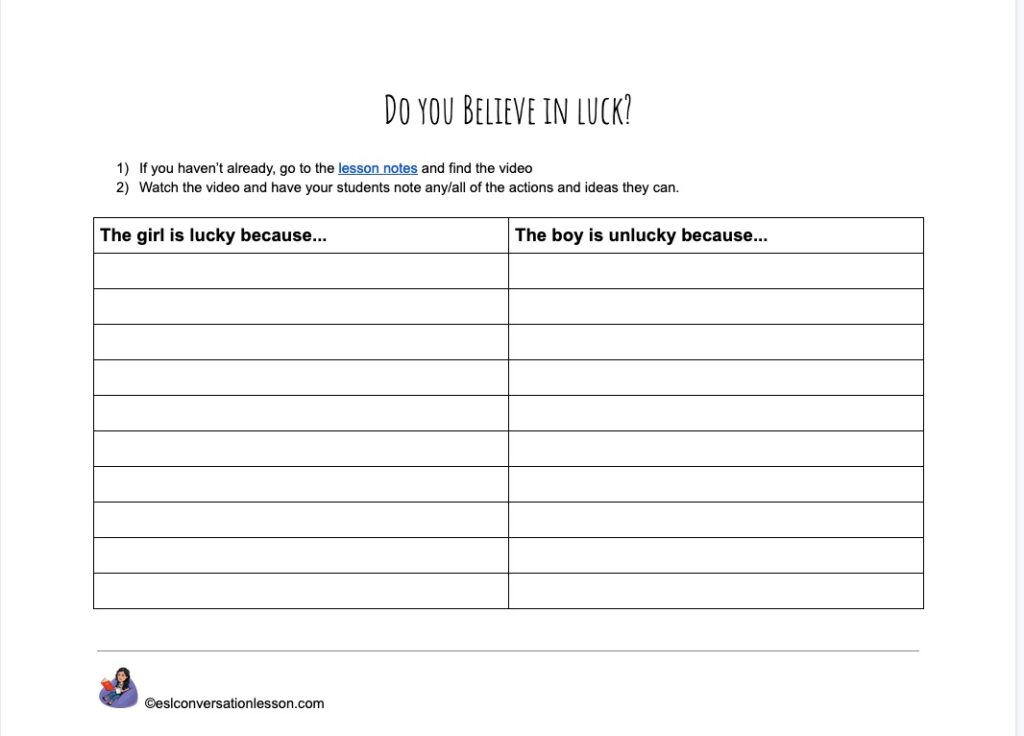
When I taught this lesson, I used this template to collect the answers. Feel free to use it too. It is a free handout on Teacher Pay Teachers. I included the results of our discussion in case you need some ideas to prime your discussion.

  • Do you think you are lucky?
  • What makes you feel lucky?
  • Does your culture have any beliefs or superstitions about luck?

The Video: Jinxy Jenkins & Lucky Lou by Mike Bidinger & Michelle Kwon

Discussion Questions

  • What actions or events in the movie make the girl (Lou) lucky?
  • What actions or events make the boy (Jinxy) unlucky?
  • Why do you think Jinxy is so unlucky? Is there anything in his attitude?
  • Why do you think Lou is so lucky?
  • What happens when they meet?
  • Why does Lou seem unhappy about being lucky?
  • Do you have any examples in your life where luck was important?
  • Would you be happy if you were as lucky as Lou?

What’s the weather today?

I love talking about the weather. It is the easiest way to initiate a conversation with a stranger or acquaintance if you need to break the silence. Great for elevator rides, spontaneous waiting time and warm repartee.

It is also a ubiquitous element that can have multiple impacts on our lives. Indeed a rainy day, bright sun, or a snowstorm will change how we dress, the meals we eat, the activities we plan and perhaps how we get to work. Personally, I check the weather every morning because I take my bike to work–even in winter.

Moreover, I find weather phenomena fascinating. Tsunamis, earthquakes,  tornadoes, nature has a way of reminding us who is really in control. Beautiful, powerful, terrifying the planet is a person. She breathes, she aches and she speaks. Are we listening?

This particular discussion lesson goes from general to scientific to silly. The objective is to elicit the vocabulary around a familiar topic and add a level of complexity with either the science behind weather or weather-related expressions. I just couldn’t choose, so I put everything.

Pre discussion

  • What are the different types of weather or climates you can name?
  • What affects the weather?
  • How does the weather make you feel? When it rains, when it is sunny when the snow falls…
  • How do you use the weather forecast?
  • What activities do you do in spring, summer, fall and winter?
  • What are the seasons like in your country?

Option 1: The Video: The Science of Weather

  • Divide the video into 2 or 3 segments and do a Tell Back  of the main themes and words
  • How do meteorologists sort through information, identify trends, and make predictions?
  • Why do they often get it wrong?
  • Why is it important to predict the weather?

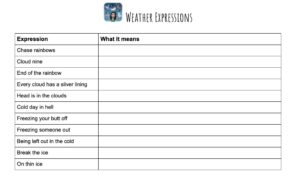
Option 2: Weather idioms

For this, I made a handout and some flashcards. They are on Teachers Pay Teachers TPT. Click to see the handout.

Try something new for 30 days

I recently read the book The Midnight Library by Matt Haig. In the book, the main character visits a library in a parallel dimension where each book represents one of her possible lives…should she have made different choices. The journey takes us into multiple different versions of this character, Nora Seed. She is a rock star, a mother, a glaciologist, an Olympic swimmer, a philosophy professor and the list goes on. In each life, Seed has the luxury of measuring the level of happiness and fulfillment the different paths procure her.

What if

It is the classic “what if”, question. Of course, it got me thinking of my own life. Then, instead of delving into regretted choices or getting depressed about what could have been, I thought of this TED talk by Matt Cutts: Try something new for 30 days. Since we cannot travel into parallel universes to see what could have been, Cutts’ idea is the next best thing.

Parallel Lives for 30 Days

We have all heard it before, we must step out of our comfort zone to grow…right? Cutt’s takes this to the next level with his self-imposed 30-day challenge. What I like about Cutt’s talk, is it gives a more tangible objective to this idea of trying new things. It may not be as profound as the Midnight Library, but it’s a start. After all, what’s 30 days?

Warm-up

  • What new thing would you like to try but haven’t yet?
  • What does it mean to “step out of your comfort zone”?
  • What are the benefits of doing new things? Any disadvantages?
  • What are the benefits of sticking with what you know? Any disadvantages?

The Video: Try something new for 30 days

Discussion Questions

  • Why does Matt think this is a good idea?
  • What did it change in his life?
  • What areas of our lives could we apply this to? Make a Mind Map
  • Do you have any spontaneous ideas that you might like to try for 30 days?


3
2
4
3
11